
Screw Guide: Understanding Screw Head Types, Threads, Tips, and Applications
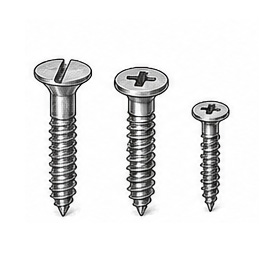
Screws are one of the most widely used fasteners in construction, manufacturing, and assembly. While they may appear simple, screw performance depends on several key design elements, including head type, drive style, thread form, and tip design. Understanding these elements helps buyers select the correct screw for strength, efficiency, and long-term reliability. This illustrated guide provides a clear visual overview of the most common screw configurations, making it easier to identify, compare, and select the correct screw for any project.
1. Screw Head Types
The screw head determines how the screw sits on the surface and how load is distributed.
| Head Type | Surface Finish | Load Distribution | Typical Applications | Buyer Notes |
|---|---|---|---|---|
| Flat (Countersunk) | Flush | Medium | Wood, drywall, furniture | Best for clean surface finish |
| Pan Head | Raised | Medium | Sheet metal, electrical | Easy alignment, good general use |
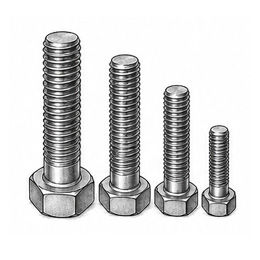
| Hex Head | Raised | High | Structural, heavy-duty | High torque, wrench-driven |
| Truss Head | Low-profile | Wide | Thin sheet metal | Reduces pull-through risk |
| Bugle Head | Flush/curved | Even | Drywall installation | Prevents surface cracking |
2. Drive Types (Recess Styles)
| Drive Type | Torque Capacity | Cam-Out Risk | Installation Speed | Recommended For |
|---|---|---|---|---|
| Phillips | Medium | High | Fast | General-purpose use |
| Pozidriv | Medium–High | Medium | Fast | Improved control vs Phillips |
| Square (Robertson) | High | Low | Very fast | Production assembly |
| Torx (Star) | Very High | Very Low | Very fast | Power tools, industrial use |
| Hex (Internal / External) | Very High | Very Low | Moderate | Structural applications |
The drive type affects installation speed, torque transfer, and tool compatibility.
3. Screw Thread Types
| Thread Type | Holding Strength | Material Compatibility | Common Uses | Buyer Consideration |
|---|---|---|---|---|
| Coarse Thread | High in soft materials | Wood, drywall | Construction | Faster driving, strong grip |
| Fine Thread | High in metal | Steel, aluminum | Machinery, metal framing | Better vibration resistance |
| High-Low Thread | Medium–High | Plastic, thin metal | Electrical, HVAC | Improved pull-out resistance |
| Drywall Thread | Optimized | Gypsum board | Drywall systems | Prevents board damage |
| Self-Tapping Thread | High | Metal, plastic | Sheet metal | Eliminates pre-tapping |
4. Screw Tip (Point) Types
| Tip Type | Pre-Drilling Required | Penetration Ability | Typical Applications | Buyer Advantage |
|---|---|---|---|---|
| Sharp Point | No | Medium | Wood, drywall | Easy start |
| Blunt Point | Yes | Low | Machine screws | Precise alignment |
| Self-Tapping Point | No | Medium–High | Thin metal | Reduces installation steps |
| Self-Drilling (Tek) Point | No | Very High | Steel-to-steel | Saves labor time |
5. Application-Based Screw Selection Table (Buyer Quick Guide)
| Application | Recommended Head | Thread Type | Tip Type | Finish |
|---|---|---|---|---|
| Drywall to wood stud | Bugle | Drywall thread | Sharp | Black phosphate |
| Drywall to steel stud | Bugle | Fine drywall thread | Self-drilling | Black phosphate |
| Wood construction | Flat / Hex | Coarse | Sharp | Zinc plated |
| Sheet metal fixing | Pan | Self-tapping | Self-tapping | Zinc plated |
| Steel framing | Hex | Fine | Self-drilling | Zinc / Ruspert |
A screw’s performance depends on the correct combination of head type, drive style, thread design, and tip geometry. Understanding these elements allows buyers to specify the right screw for each application, reduce installation problems, and improve long-term reliability. Manufacturers such as JLHY Fasteners design screw ranges using these criteria to ensure consistency, compatibility, and export-ready quality.